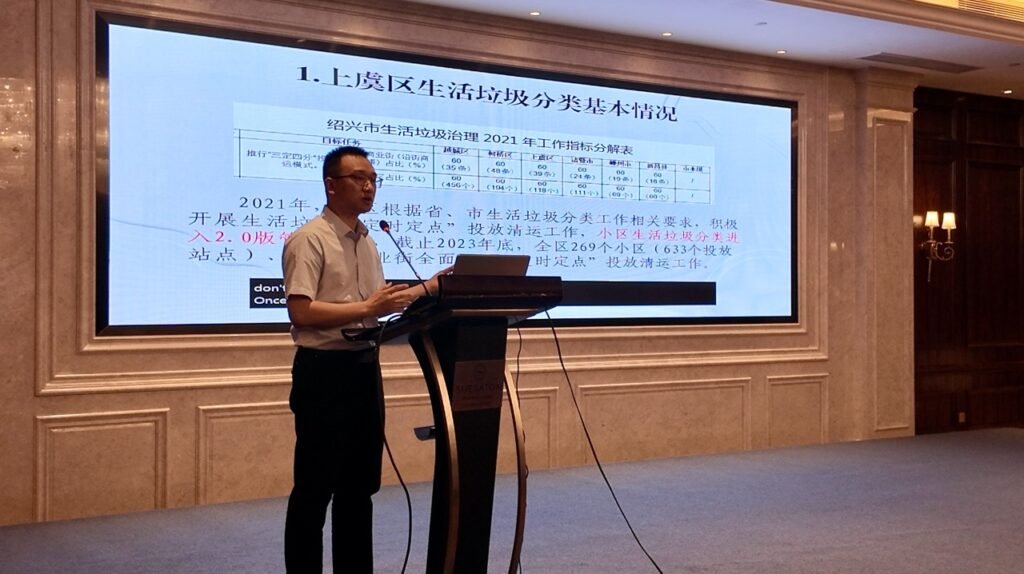
From May 12 to 16, 2025, the Asian Development Bank (ADB) hosted a specialized seminar on “Circular Economy and Sustainable Solid Waste Management” in Shaoxing, Zhejiang Province. Lu Kai, Director of the Shangyu District Urban Management and Law Enforcement Bureau, was invited to deliver a keynote presentation, offering an in-depth overview of Shangyu’s journey in household waste classification, its innovative governance models, and future development strategies. He particularly highlighted the district’s pioneering “Property Management Plus” (Property+ or “Wuye+”) model, presenting a compelling case study in urban governance refinement.
Director Lu outlined Shangyu’s progressive evolution in waste management since 2015, when pilot programs were first launched in urban areas. By 2016, the initiative had expanded citywide to cover all rural regions. In 2021, Shangyu fully implemented a time- and location-specific waste collection system. The district’s waste classification efforts have now advanced from Phase 1 (pilot exploration) and Phase 2 (standardized management) to Phase 3—a co-governance model centered on the “Property+” framework.
Currently, 269 residential communities and 120 commercial streets across the district operate under the designated time-and-place collection system. Daily municipal solid waste generation stands at approximately 880 tons, with a per capita output of 1 kilogram.
A centerpiece of Lu’s presentation was the innovative “Property+” model, launched in 2023. This approach designates property management companies as key operational entities in waste classification. Through policy incentives and institutional support, property firms are empowered and required to take responsibility for maintaining sorting infrastructure, public education, on-site supervision, and waste collection logistics.
To ensure sustainability and engagement, Shangyu has introduced a subsidy mechanism providing RMB 260 per household annually to participating property management companies. In 2024 alone, the district disbursed a total of RMB 18 million in subsidies, significantly boosting private-sector participation and accountability.
Under the “Property+” framework, Shangyu has established a multi-stakeholder governance mechanism led by sub-district offices, with coordinated efforts from government departments, neighborhood committees, property management companies, and homeowners’ associations. For instance, Baiguan Sub-district has implemented a “1515” rapid-response protocol (1-minute response, 5-minute resolution, 15-minute feedback), while Cao’e Sub-district has adopted a dual-grid system combining grid-based administration with dedicated sorting supervisors. Additionally, specialized volunteer groups such as the “Yu Xiaoshe” Public Education Team and the “Skillful Mothers” Supervision Brigade have been formed to strengthen community engagement and enforcement.
Complementing these efforts, an integrated online and offline communication strategy, combined with regular inspections, has effectively addressed persistent challenges such as illegal dumping and non-compliant disposal.
On the backend, Shangyu has developed a comprehensive waste processing infrastructure, including waste-to-energy incineration plants, centralized facilities for food waste recycling, organic waste treatment, bulky waste processing, and resource recovery sorting centers. This integrated system ensures the three core objectives of solid waste management: reduction, resource recovery, and harmless disposal.
Owing to its consistent performance, Shangyu has been recognized as an “Outstanding County-Level City in Zhejiang Province for Household Waste Classification” for four consecutive years. The “Property+” model was further honored as one of the Provincial Model Cases for Urban Household Waste Management in 2024.
Looking ahead, Lu emphasized that Shangyu will further refine the “Property+” model by advancing toward a “location-specific but time-flexible” (designated place, flexible time) Phase 3.0 system. The focus will remain on enhancing source separation quality, optimizing collection and transportation logistics, and institutionalizing long-term mechanisms. The ultimate goal is to sustainably improve resident participation and sorting accuracy, laying a solid green foundation for the development of Shangyu as a vibrant “Youth City.”